
You have done the drama classes. You have practised your monologues in the mirror at midnight. You have taken the feedback, reworked your choices, and still walked offstage feeling like something was not clicking.
What if the missing piece is not something new at all? What if it is something 500 years old? Imagine a time- no theatre, no stage lighting, no guaranteed audience. Just a dusty Italian town square, a crowd that couldn’t care less, and a troupe of performers who needed to make people stop walking and start watching.
That was the daily reality for Commedia dell’arte performers in 16th-century Italy. They still hold up today better than most techniques you’ll find in any modern acting handbook.
Let Your Body Talk Before Your Mouth Opens
Here’s something your drama teacher probably didn’t say loudly enough- your body tells the story before a single word leaves your lips. Commedia performers trained their physicality the same way athletes train their muscles. Every lean, every stumble, every exaggerated reaction was a deliberate choice that communicated character and emotion instantly without dialogue.
So ask yourself honestly — if someone muted your performance right now, would the story still land the same way? If that question makes you uncomfortable, that’s exactly where your growth is hiding.
Use a Mask to Kill Your Bad Habits
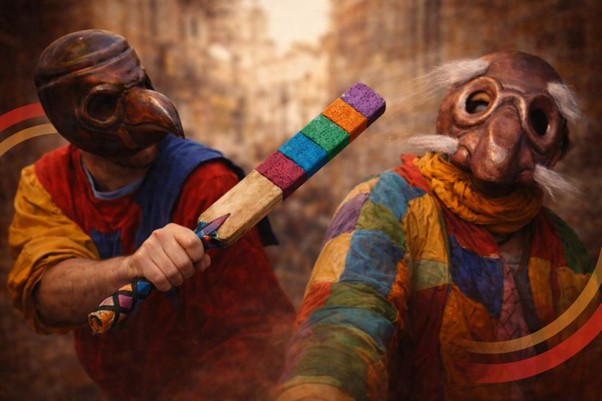
Here it gets confronting. And genuinely useful. Theatre masks were central to commedia training, and wearing one is deeply humbling for any performer. The moment your face is covered, every lazy habit you’ve been quietly relying on disappears overnight.
You can’t smirk through a scene. You can’t let your eyes do all the heavy lifting anymore. Your entire body has to step up and carry the performance. Even a few sessions working with a mask will permanently change how you think about physical commitment on stage.
Many ask what props are used in slapstick comedy. Slapstick comedy traditionally gets props, like wooden slapsticks, oversized mallets, buckets, ladders, pies, and exaggerated everyday objects. These props create comedy through sound, surprise, and physical timing rather than words, which makes an audience laugh before the performer even speaks.
Make Chaos Look Like Precision
Here’s what most people get completely wrong about physical comedy. They think it is random. But it absolutely isn’t. The use of slapstick props in Commedia dell’arte was never mucking around for a laugh. Every fall, every whack, every perfectly timed stumble was rehearsed with the same discipline a ballet dancer brings to a routine.
The chaos was a performance. The mess was the craft. Learning to make something look effortless while executing it with pinpoint accuracy is a skill that transfers directly into drama, film, and live performance today.
Earn Your Audience Every Single Second
Commedia performers had no captive audience. Nobody was obligated to watch. So they developed something priceless. The ability to read a crowd in real time and adjust without breaking character.
That instinct is largely lost in modern performance training. You walk out, the audience is already seated, and the contract feels automatic. But the moment you start performing as if you genuinely have to earn every person in that room, something shifts in your energy that audiences feel immediately.
That’s not a technique you find in a textbook. That’s something 16th-century street performers figured out the hard way — and it still works every single time.
What You Can Take Into Your Next Rehearsal
You do not need to become a commedia specialist. But borrowing even a little of this mindset, lead with your body, earn every moment, and trust physical instinct over intellectual analysis, will shift something real in your performance. The 16th century did not overthink it. Maybe you should not either.
Leave a Reply