
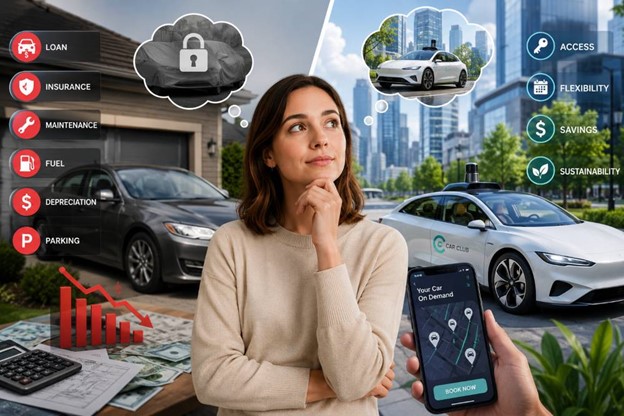
Owning a car used to feel like one of those life milestones worth celebrating. You worked hard, saved up, signed the paperwork, and drove off the lot feeling genuinely proud. That feeling is real and nobody is dismissing it. But somewhere between the monthly loan payment, the insurance renewal, the oil change reminder, and the repair bill that always seems to land at the worst possible time, that sense of pride quietly fades. The average American household now spends somewhere between ten and twelve thousand dollars a year keeping one vehicle on the road. Not buying it. Just keeping it going. That number deserves a moment of serious thought.
There is a figure that transportation researchers keep bringing up and it never stops being surprising. Personal vehicles spend roughly 95 percent of their lifetime parked. Not taking you anywhere. Not earning its keep. Just sitting in a driveway or garage while the owner keeps paying for depreciation, registration, and full coverage insurance. You are carrying the complete financial weight of ownership for something you actually use maybe one hour out of every twenty-four. When you frame it that way, the whole arrangement starts to look less like a smart investment and more like a very expensive habit that nobody ever stopped to question.
Here is the real question worth sitting with. Do you need to own a car, or do you just need reliable access to one? Those sound like the same thing but they are completely different. One costs you thousands of dollars a year in fixed overhead regardless of how much you drive. The other only asks you to pay when you actually use it. More people are landing on that distinction and finding that membership models make far more sense for how they actually live. Joining a self-driving car club membership gives you exactly that kind of on-demand access to a capable, modern vehicle without the weight of ownership anchoring your monthly budget. You get the car. You skip the burden.
Electric vehicles represent a genuine leap forward in how transportation can feel. Quieter rides, smoother acceleration, lower running costs per mile, and a significantly smaller environmental footprint compared to anything running on gas. The obstacle has always been the purchase price. A quality electric vehicle can run fifty thousand dollars or more at the dealership, which puts individual ownership out of reach for most families without taking on serious debt. But shared access rewrites that math entirely. An electric vehicle sharing membership spreads the cost of that vehicle across a whole community of users. Everyone gets to experience the best available technology. Nobody has to absorb the full financial hit alone.
Less privately owned vehicles in circulation means less idle metal sitting on neighborhood streets all day. Less exhaust pollution drifting through residential areas. Less demand for the sprawling parking infrastructure that eats up so much valuable community space. Beyond the environmental angle, there is something personally meaningful happening here too. People making this shift are reporting less financial stress, more flexibility in their monthly spending, and a quiet sense of relief that comes from letting go of a depreciating asset they never really needed to own in the first place. Giving up ownership is not giving up freedom. For a growing number of Americans, it turns out to be the exact opposite.
Leave a Reply